
Checking Criminal History in Erie County
No one database contains every Erie County criminal record. Begin with the event you need to prove. Pending Erie County Court and Buffalo City Court cases may appear in WebCriminal. Closed felony files go through the Erie County Clerk. A recent police report remains with the arresting agency, while a booking record belongs to the Erie County Sheriff's Office if the person entered county custody. The subject of a record can use DCJS fingerprint review for the official New York rap sheet.
Names alone can produce a weak match. Gather the full court spelling, date of birth, possible former names, incident date, and any docket, indictment, report, or warrant number. Then follow the record to its custodian:
- Decide whether the goal is a pending case, closed felony, police report, custody check, warrant, or personal state history.
- Search the matching official system or contact the office that created the Erie County record.
- Match the court, date, and case number rather than relying on a similar name.
- Request the underlying file or Certificate of Disposition when the outcome matters.
- Compare that court result with a personal DCJS review if the state history appears wrong.
Note: A no-result screen does not prove that no Erie County arrest, sealed matter, older local case, or spelling variation exists.
Erie County Criminal Records Corridor
Downtown Buffalo places several Erie County record offices within a few blocks, yet each counter has a separate job. The Erie County Court Building at 25 Delaware Avenue handles felony court work. The County Clerk's public-record operation at 92 Franklin Street indexes closed Supreme and County Court felony files. Buffalo City Court at 50 Delaware Avenue keeps city-level criminal files and conducts felony arraignments. Sheriff headquarters, the Holding Center, and the District Attorney also sit in the same corridor.
Physical closeness does not merge custody. The County Clerk cannot produce a Buffalo Police incident report. Buffalo City Court cannot certify a County Court outcome. Sheriff staff cannot turn a local jail intake into a full state rap sheet. A request works best when it names the right office and a specific record. For a closed felony search by name, the Erie County Clerk requires a date of birth. An indictment number is even more precise.
The Erie County Clerk's criminal-proceedings page shows how felony files are divided from lower-court matters.
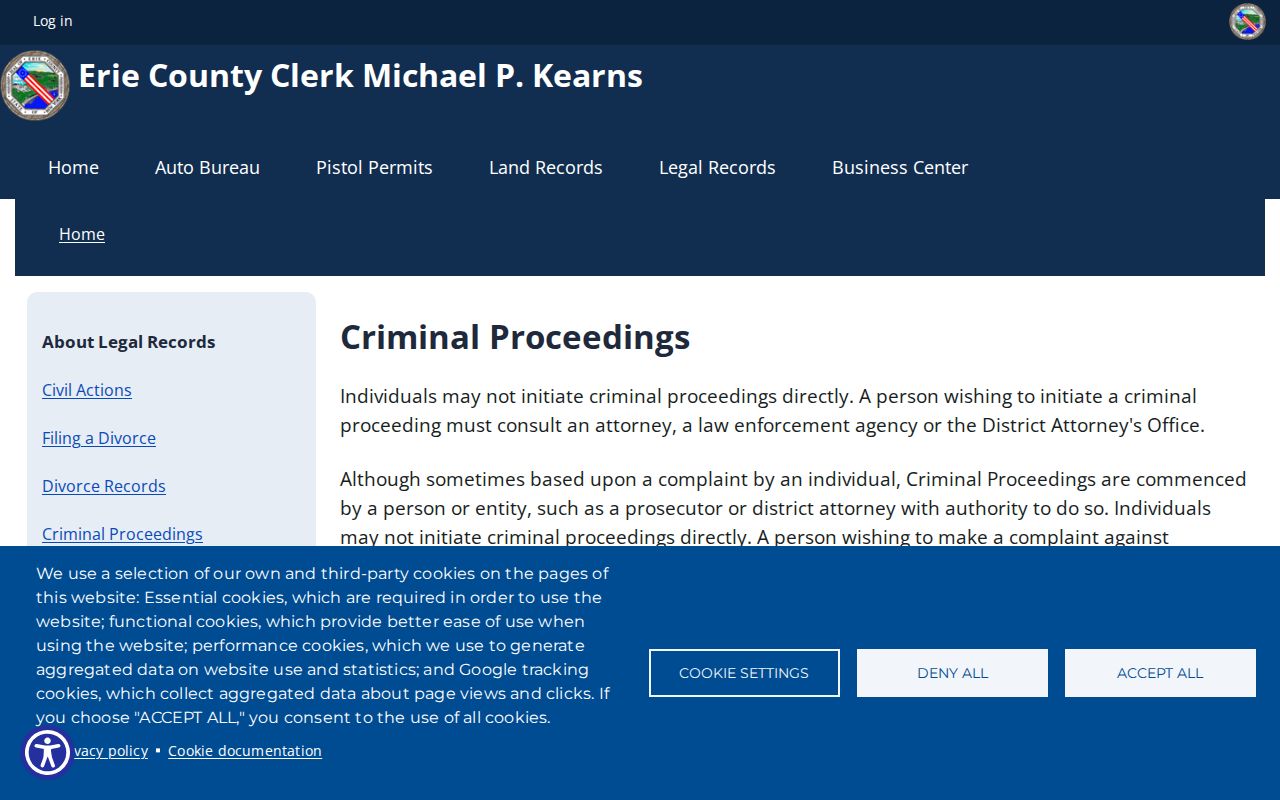
That division explains why the court of origin must be identified before an Erie County criminal record request is sent.
New York Official Background Checks
The New York State Division of Criminal Justice Services, or DCJS, maintains fingerprint-supported criminal histories. Its Record Review is for the subject of the record or that person's attorney. It is not a public name search. An applicant enrolls through IdentoGO with service code 15464Z for a suppressed response or 15465F for an unsuppressed response. The listed in-state appointment cost is $47.50 as of February 2, 2026. DCJS mails the result.
OCA Criminal History Record Search, known as CHRS, is a different product. Anyone may order an exact full-name and date-of-birth search for $95 per combination. It covers public electronic court data, but the result is not certified. It omits sealed matters and several other classes of cases. A person's own FBI Identity History Summary adds a federal layer, while an Erie County sheriff form reaches only local ECSO arrest files.
| Official channel | Identity basis | Located cost | Result |
|---|---|---|---|
| DCJS in-state review | Fingerprints | $47.50 | Own New York history |
| DCJS Cardscan | FD-258 prints | $17.50 plus local print cost | Own history from outside New York |
| OCA CHRS | Exact name and DOB | $95 per combination | Public court-data history |
| ECSO personal check | Notarized form | Confirm with ECSO | ECSO arrest files only |
Enrollment begins through the official IdentoGO service-code channel.
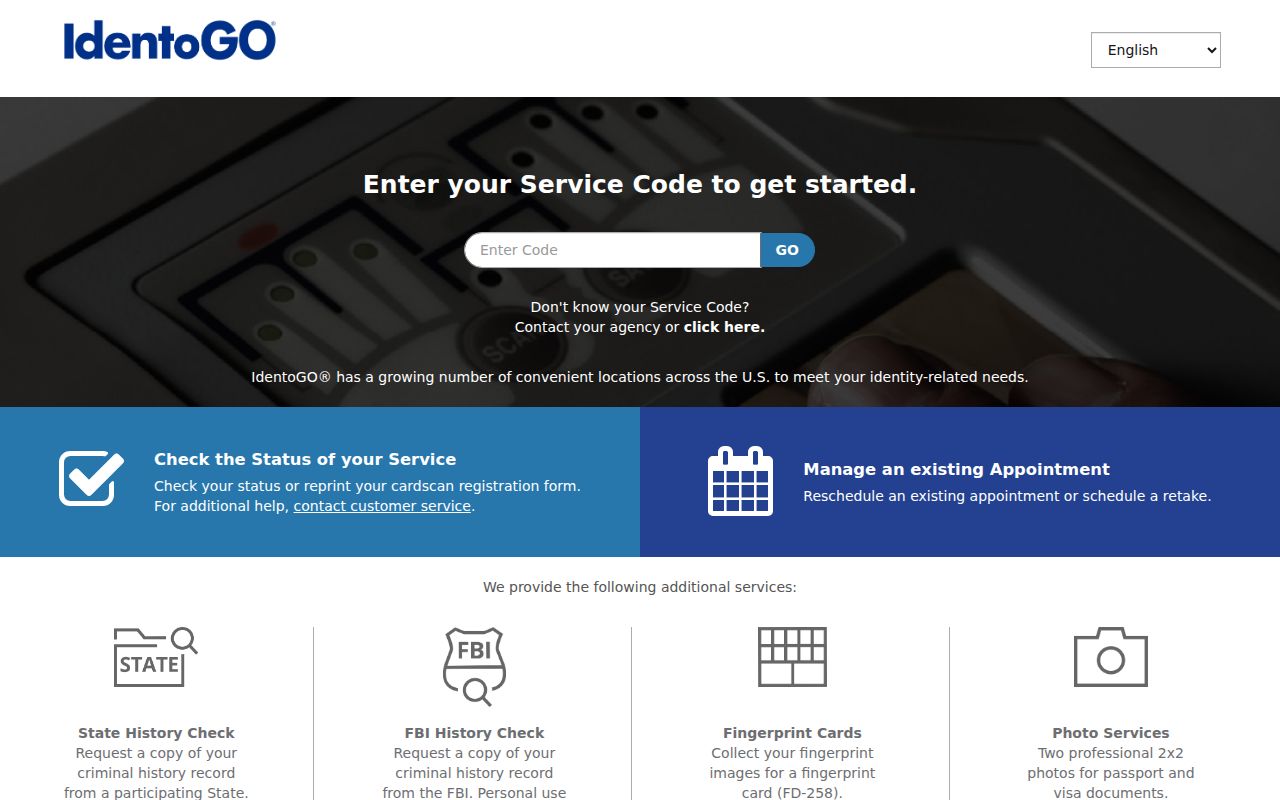
Enter the correct DCJS code before choosing a current Erie County-area fingerprint location, since appointment sites can change.
Erie County Court Search Channels
Three court channels answer three different questions. WebCriminal is free and focuses on pending supported criminal cases. OCA CHRS produces a statewide public name-and-birth-date report with exclusions. The Erie County Clerk supplies closed felony material held by the Clerk. Older town or village records may require a direct call to the justice court, especially because OCA warns of incomplete local disposition data from earlier periods.
WebCriminal lets a reader search by defendant name or case number. Select the correct court. Erie County Court and Buffalo City Court are the main supported local choices noted in the research. The result may show a court, part, status, docket or indictment number, and next date. It is case information, not a promise that every pleading can be downloaded. The full Erie County criminal court case record remains with the originating clerk.
| WebCriminal field | Input | Use |
|---|---|---|
| Search By | Defendant or case number | Choose the matching route |
| Last and First Name | Court spelling | Find a named defendant |
| Court | Dropdown | Narrow to the proper Erie court |
| Case or Indictment Number | Local identifier | Reach a specific matter |
Criminal Record Types
Erie County criminal records reflect separate stages. A police agency creates an incident or arrest report. ECSO creates a booking file when someone enters the Holding Center or Correctional Facility. A complaint, information, or indictment starts a court case. The court later records pleas, motions, disposition, and sentence. Fingerprintable events can flow to DCJS as arrest and prosecution cycles.
Other records serve narrower purposes:
- Warrant records begin with a court order and may appear on the Sheriff's public subset.
- Probation records concern a local sentence supervised by Erie County Probation.
- Parole records concern state community supervision handled through DOCCS.
- Registry records are DCJS SORA entries with public visibility tied to New York risk rules.
- Jail and prison records separate Erie County custody from DOCCS and federal custody.
An arrest charge can be reduced, replaced, dismissed, or never prosecuted. For that reason, the Erie County arrest lookup channels should be paired with the court disposition before drawing a conclusion.
Erie County Jail Record Fallbacks
Erie County does not publish an official public jail-roster search in the researched sources. Use the fallback chain. Call the Holding Center at 716-858-7638 or the Correctional Facility at 716-937-9101 when current custody is the question. Request releasable booking material from ECSO when a record copy is needed. Check the court for the filed charge and bail or release order. DOCCS Incarcerated Lookup applies only after a person enters state custody, and the federal BOP locator is separate again.
The two Erie County jail sites also differ. The seven-story Holding Center at 40 Delaware Avenue opened in 1937 and has a listed maximum capacity of 638. The medium-security Alden Correctional Facility at 11581 Walden Avenue opened in 1985 and has a listed maximum capacity of 746. Those facts help identify which number to call, but neither facility record proves guilt.
The official Erie County Sheriff's Office site is the current starting point for jail and records contacts.
The sheriff source ties custody questions to ECSO, while court outcomes stay with the relevant Erie County or local court.
Inside an Erie County Criminal Record
The contents depend on the file. A rap sheet groups identity data and arrest cycles, then prosecutor and court action, sentences, custody, or supervision. A court file follows one case by docket or indictment number. A jail record emphasizes intake, lodged charges, facility, bail, and release. A public warrant list is much narrower and should never be read as a full criminal history.
| Name and identifiers | Legal name, aliases, birth data, NYSID, or other control numbers when lawfully shown. |
|---|---|
| Arrest and booking data | Date, agency, initial charges, intake, custody location, and release events. |
| Charges and statutes | Offense descriptions and cited laws, which may change as the case moves. |
| Disposition | Dismissal, acquittal, plea, conviction, or another final status for each count. |
| Sentence | Jail, prison, probation, fine, restitution, or other court-ordered terms. |
| Custody or supervision | County jail, state custody, probation, or parole information where released. |
Protected fields may be removed. Full Social Security numbers, victim identities, juvenile data, medical details, and active investigative facts are not routine public fields. A Certificate of Disposition from the court of origin is the certified answer to a case outcome.
Erie County Warrant Record Checks
ECSO publishes a public outstanding-warrant list with fields such as warrant number, reason, date received, last known address, and a physical description. It is a useful lead, not a complete countywide warrant index. The Sheriff's page warns that entries can become stale. It also tells readers not to attempt an apprehension. Location tips go to 716-858-2903, and questions about an incorrect or old entry go to the Warrant Office at 716-858-3287 during listed weekday hours.
City, town, and village courts may issue bench warrants that are not on the ECSO list. A missed Lackawanna court date, for example, should be checked with that court. Search warrants and sealed indictments are not expected on a public wanted-person page. Someone resolving their own warrant should confirm the issuing court, number, charge, hours, and possible bail or remand terms before arranging an appearance with counsel or the court.
The Erie County Sheriff warrant page carries the current list and its safety warnings.
Public Access Laws in New York
New York Freedom of Information Law, or FOIL, creates a presumption of access to agency records, subject to exemptions. It does not unseal a court file. Requests should reasonably describe the report, date, place, agency, and desired format. Erie County offices run separate FOIL processes, so a Sheriff's report request should go to ECSO Professional Standards, not the County Clerk.
The current ECSO route is 40 La Riviere Drive, Suite 140, Buffalo, NY 14202, or psdfoils@erie.gov. Approved material is held until an invoice is paid by check or money order. If electronic delivery needs a device, ECSO supplies it and charges the cost rather than using requester media. Privacy, active enforcement, safety, juvenile protection, and sealing can support withholding or redaction.
Key New York laws:
Public Officers Law Article 6 sets FOIL access and appeal procedures.
Judiciary Law §255 governs lawful court-file searches and certified records.
CPL 160.50 seals records after a favorable termination.
CPL 160.59 permits applications to seal eligible convictions.
Correction Law Article 6-C controls registry classification and public release.
Erie County Criminal Record Terms
Erie County court and history files use terms that mark different steps. Reading them as synonyms can distort the result. These core terms help separate an accusation from a final outcome:
- Arraignment
- The first court appearance where charges and rights are stated and a plea is entered.
- Indictment
- A grand jury's formal felony accusation, indexed in closed Erie County felony files.
- Disposition
- The status or outcome that resolves a charge or case.
- Certificate of Disposition
- The certified outcome issued by the originating court, unlike an OCA CHRS result.
- Bench warrant
- A court order often issued after a person fails to appear or comply.
- Sealing
- A limit on public access that preserves access for people or agencies authorized by law.
Erie County also has specialty courts. Buffalo, Lackawanna, and Tonawanda appear in the Eighth Judicial District treatment-court network, and Buffalo City Court hosts a Human Trafficking Intervention Court. Ordinary docket events may remain in the court file, but confidential treatment and service material should not be assumed public.
Sealed, Expunged, and Restricted Records
New York mainly uses record sealing. Favorable terminations, acquittals, and many dismissals are generally sealed under CPL 160.50. CPL 160.55 addresses specified noncriminal outcomes. Youthful-offender and juvenile matters have separate confidentiality rules. Redaction may protect victim names, minors, account numbers, or investigation details without sealing the whole file.
CPL 160.59 allows an application to seal some convictions after at least ten years from sentence or release, whichever is later. Its eligibility limits and offense exclusions matter. CPL 160.58 can conditionally seal certain treatment-related drug cases. The Clean Slate Act, CPL 160.57, took effect November 16, 2024 and gives OCA up to three years to build the automatic process. DCJS warns that a record review may still show an expected-to-seal conviction until qualifying data are implemented and transmitted.
New York uses true expungement for specified cannabis convictions. That is not the same as ordinary sealing. File a sealing request with the originating Erie County court, obtain Certificates of Disposition, and use DCJS verification after an order. A FOIL request cannot reopen sealed material.
Correcting Erie County Criminal History
A missing disposition can make an arrest look unresolved. Start with the court that handled the Erie County case. Ask for a Certificate of Disposition and any signed sealing order. Compare the court's record with a fresh fingerprint-based DCJS Record Review. Then follow the challenge instructions included with the state response and attach the court proof. DCJS also publishes seal-verification forms for CPL 160.50, 160.55, and 160.59.
The DCJS Record Review page explains service codes, challenges, and sealing verification.
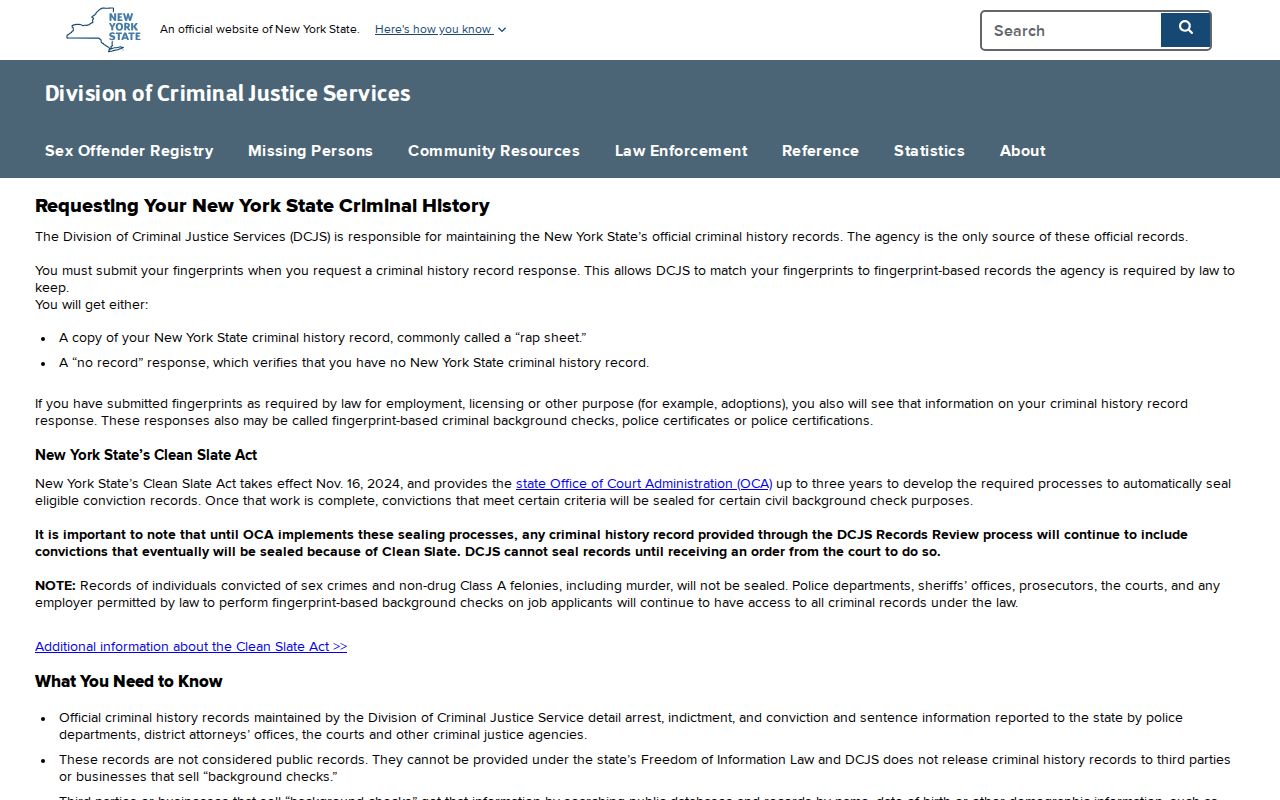
This state process uses fingerprints, which helps prevent a similar name from being mistaken for the subject's Erie County criminal record.
Erie County Supervision Records
Probation and parole are separate systems. Erie County Probation, at One Niagara Plaza in Buffalo, runs Adult and Juvenile divisions with about 150 staff. Adult officers prepare presentence reports for local courts and supervise county probation sentences. There is no researched public probation name-search portal. Verify the sentence with the court, then direct lawful status questions to Probation at 716-858-8200.
DOCCS handles parole and other state community supervision. Its Southern Tier Sub-Area Office at 460 Main Street serves Erie County. The state incarcerated lookup may show custody or release facts, but supervision terms and investigative violation material can be restricted. A release date alone should not be used to infer current status.
The Erie County Probation overview identifies its local structure and work.
The agency description shows why a court sentence and the later supervision file answer related but different record questions.
Erie County Criminal Charge Pipeline
An Erie County arrest begins a chain, not a final result. The arresting agency writes the first report. If the arrest is fingerprintable, identity data can reach DCJS. ECSO creates a booking record when county custody begins. A local court handles arraignment. A felony may move through a 23-person grand jury to Erie County Court or Supreme Court, followed by motions, plea or trial, a Probation presentence report, and sentencing.
Arrest → Booking → Local Arraignment → Grand Jury when applicable → Plea or Trial → Disposition → Sentence
The Erie County District Attorney source reports litigating about 25,000 matters each year across local, county, state, and specialty courts. That is a caseload figure, not a conviction count. Erie County criminal records should be read at their stage in this flow, since initial police charges may differ from an indictment or final conviction.
The local prosecution source helps place charging and grand-jury records between the arrest report and the final court disposition.
Erie County Criminal Records by City
Buffalo, Lackawanna, and Tonawanda are Erie County's three incorporated cities. Each police department creates its own reports, and each city court keeps its local case trail. Buffalo has a City Court Booking records clearinghouse and a daily preliminary incident dataset. Lackawanna routes city FOIL requests through its clerk and lists set criminal calendar days. Tonawanda's court and police channels remain distinct from the Town of Tonawanda. Felonies and county custody can later move into Erie County systems.
Buffalo Criminal Records
Buffalo Police reports, City Court files, WebCriminal, and the county-seat record corridor.
Lackawanna Criminal Records
City Clerk FOIL, Police front desk, City Court calendars, and Erie County felony routing.
Tonawanda Criminal Records
City Police and Clerk requests, the Niagara Street court, and county-level case transfer.
Choose the city where the report or first court case began. Then follow any felony indictment or county jail placement into the Erie County office that took custody of the next record.