
Erie County Criminal Court Cases
Erie County criminal court cases do not all reach the same counter. Buffalo, Lackawanna, and Tonawanda city courts hear misdemeanors and lesser offenses, and they conduct the first steps in felony cases. Town and village justice courts keep matters that arise within their own borders. After a grand jury votes an indictment, a felony ordinarily proceeds in Erie County Court, while New York Supreme Court also has felony jurisdiction. Federal criminal cases belong to the Western District of New York and sit outside this county system.
The Erie County Clerk criminal proceedings office indexes closed felony files from County and Supreme Courts. It searches by defendant name and indictment number; a request by name also needs a date of birth. Lesser charges that remained in a city, town, or village court never become Erie County Clerk files. That split is the first fact to settle before asking for a docket, judgment, or certificate.
Erie County Court Records Compared
Erie County criminal case access is concentrated in downtown Buffalo, yet each office has a distinct job. The Erie County trial courts at 25 Delaware Avenue handle felony proceedings. The Erie County Clerk at 92 Franklin Street holds the closed felony record. Buffalo City Court at 50 Delaware Avenue keeps its own misdemeanor and preliminary felony file. Calling the wrong office can yield an accurate “no record” response for a case stored a few blocks away.
| Office | Erie County record role | Contact |
|---|---|---|
| Supreme and County Court | Felony trials and post-indictment proceedings | 25 Delaware Ave.; 716-845-9300 |
| Erie County Clerk | Closed County/Supreme felony files | 92 Franklin St.; FOIL 716-858-6636 |
| Buffalo City Court | Misdemeanors and felony preliminary stages | 50 Delaware Ave.; records 716-845-2661 |
The Sheriff Jail Management page shows how custody records remain separate from a criminal court case.  A jail entry may help locate a person, but only the court docket shows the filed charge and later disposition.
Searching Erie County Case Records
eCourts WebCriminal is the free starting point for supported pending Erie County Court and Buffalo City Court matters. It is case information, not a scanned-document library. Searchers should copy the court, case or indictment number, part, status, and next appearance, then confirm them with the originating clerk.
- Choose Defendant Name or Case Number in WebCriminal.
- Enter the court spelling of the first and last name, or the case identifier.
- Select Erie County Court or Buffalo City Court as appropriate.
- Read the result for its court, part, status, and next date.
- Ask that court for the file or a Certificate of Disposition.
| Field label | Type | Required | Notes |
|---|---|---|---|
| Search By | Tab/control | Yes | Defendant Name or Case Number |
| Last Name | Text | Name route | Use the court spelling |
| First Name | Text | Name route | Pair with last name |
| Court | Dropdown | Yes | Select the originating court |
| Case/Indictment Number | Text | Number route | Local court identifier |
WebCriminal covers supported pending matters, so the Erie County Clerk or originating lower court remains essential after a case closes. The official court number also guards against a false match between people who share a name.
When Erie County Case Search Fails
A WebCriminal no-match does not establish that no Erie County case exists. The matter may be closed, sealed, filed under a different spelling, held in a town or village court, or outside WebCriminal coverage. Older electronic gaps also matter. OCA warns that town and village disposition data is unavailable from May 1991 through 2002 and limited from 2002 through 2007.
Start with the place and level of the alleged case. Ask the city, town, or village clerk about its own docket. For a closed felony, provide the Erie County Clerk with the name, birth date, or indictment number. For a broad public New York court-data search, OCA CHRS costs $95 per exact name and birth-date combination, but it is not certified and has listed omissions. A Certificate of Disposition from the original court is the certified outcome.
The Erie Sheriff FOIL page illustrates a different records channel.  Use that route for releasable Sheriff records, not for a judgment held by a court clerk.
Inside an Erie County Case File
An Erie County criminal case file follows one prosecution. It differs from a fingerprint-based DCJS rap sheet, which organizes statewide arrest and prosecution cycles. The court file can show the formal accusation, events, plea, ruling, disposition, and sentence. Public online results may summarize those facts without providing each paper filed in court.
| Case number and court | The docket or indictment identifier, court, and assigned part. |
|---|---|
| Charging document | Complaint, information, or grand-jury indictment defining filed counts. |
| Docket entries | Arraignments, appearances, motions, adjournments, pleas, and rulings. |
| Hearing dates | Past calendar activity and a next date when one is scheduled. |
| Disposition and judgment | Dismissal, acquittal, plea, verdict, or other resolution. |
| Sentence | The court-imposed term, probation, fine, surcharge, or restitution where recorded. |
Victim identities, Social Security numbers, juvenile material, and sealed records are not ordinary public fields. A public docket also should not be described as a full police narrative or DCJS NYSID history.
Reading Erie County Court Terms
Short Erie County docket entries make more sense when each term is tied to its procedural job. A status line is not always an outcome. “Adjourned,” for example, means a new date was set; it does not mean the count was dismissed.
- Indictment
- A grand jury's formal felony accusation, indexed by number in closed Erie felony files.
- Disposition
- The result that resolves a charge or case.
- Remand
- Detention without release while proceedings continue.
- ROR
- Release on recognizance without money bail or pretrial supervision.
- Certificate of Disposition
- The originating court's certified statement of the case outcome.
The Buffalo preliminary incident dataset is sometimes mistaken for a court docket. 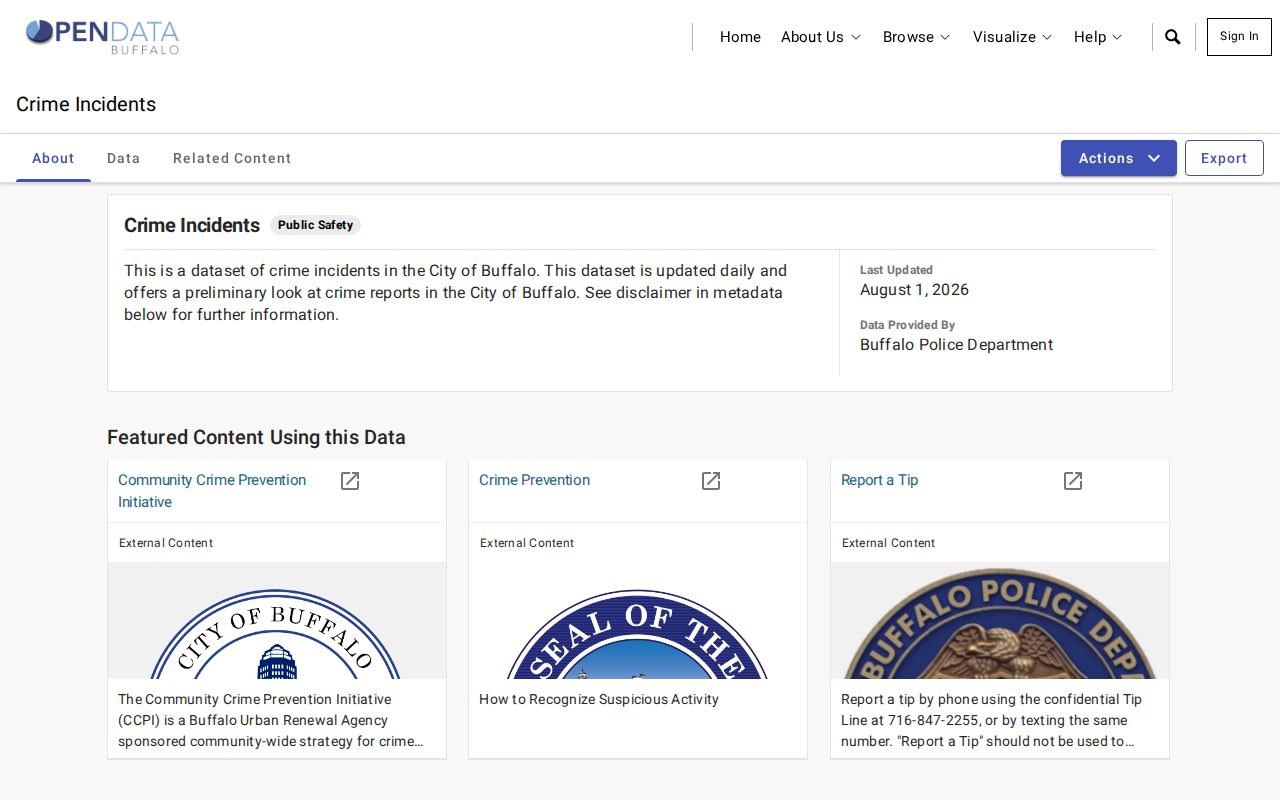 Its incident fields can provide context, but they do not supply a plea, judgment, or sentence.
How a Criminal Case Moves
The Erie County District Attorney describes a local felony path that begins in a local criminal court. Counsel and release status are addressed early. A felony complaint can then go before a 23-person grand jury. If that body votes an indictment, the case reaches superior-court arraignment, discovery, motions, and either a plea or trial. Probation may prepare a presentence report before sentence.
Case flow: Charges Filed › Arraignment › Pretrial › Plea or Trial › Disposition › Sentencing
The Erie DA criminal court process presents that route in local terms. 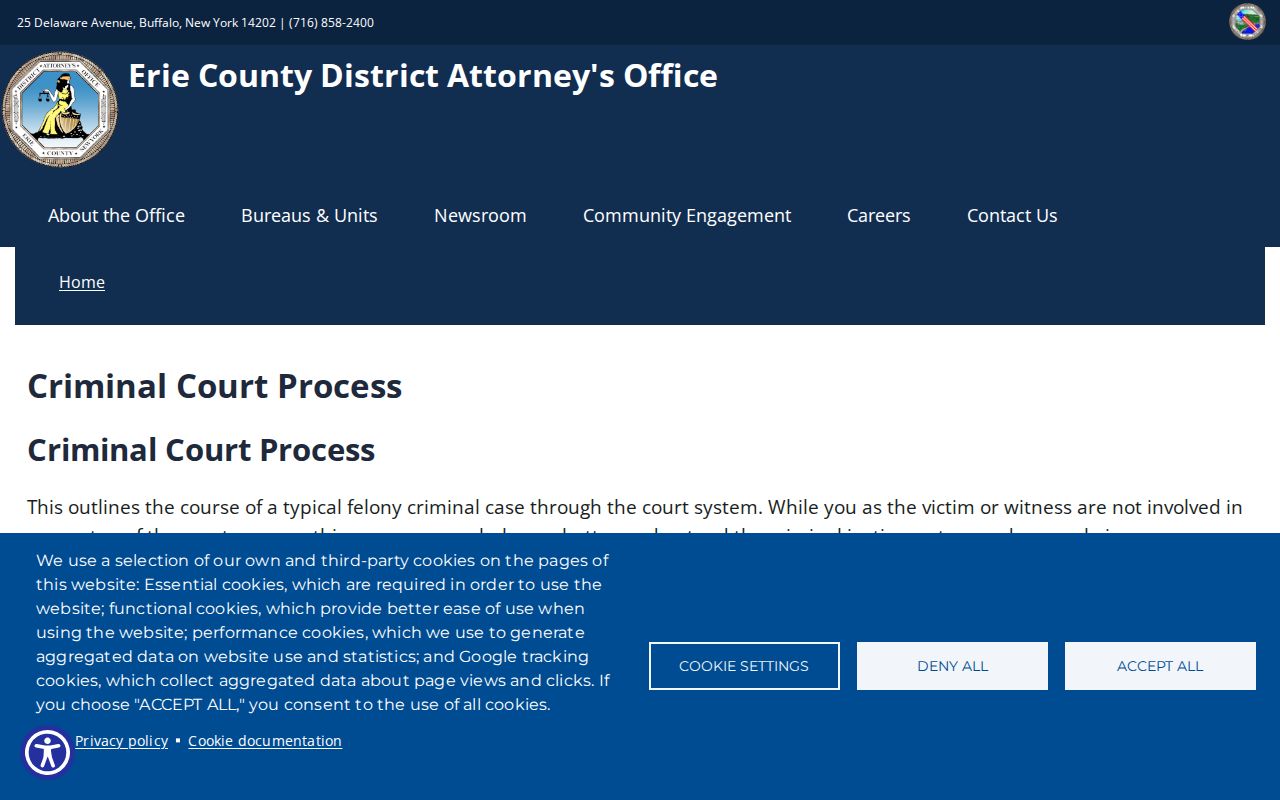 The pictured sequence helps explain why the initial arrest charge may not match the final indicted or convicted count.
Erie County Specialty Court Records
Buffalo, Lackawanna, and Tonawanda appear in the Eighth Judicial District treatment-court network. Buffalo City Court also hosts a Human Trafficking Intervention Court. These programs still generate ordinary Erie County case entries, but clinical, service, and treatment details can be confidential. A public docket does not make every program record open.
Use the docket to identify the court and status, then ask that clerk what can lawfully be inspected. The Tonawanda City Court page documents one local counter and its access features. 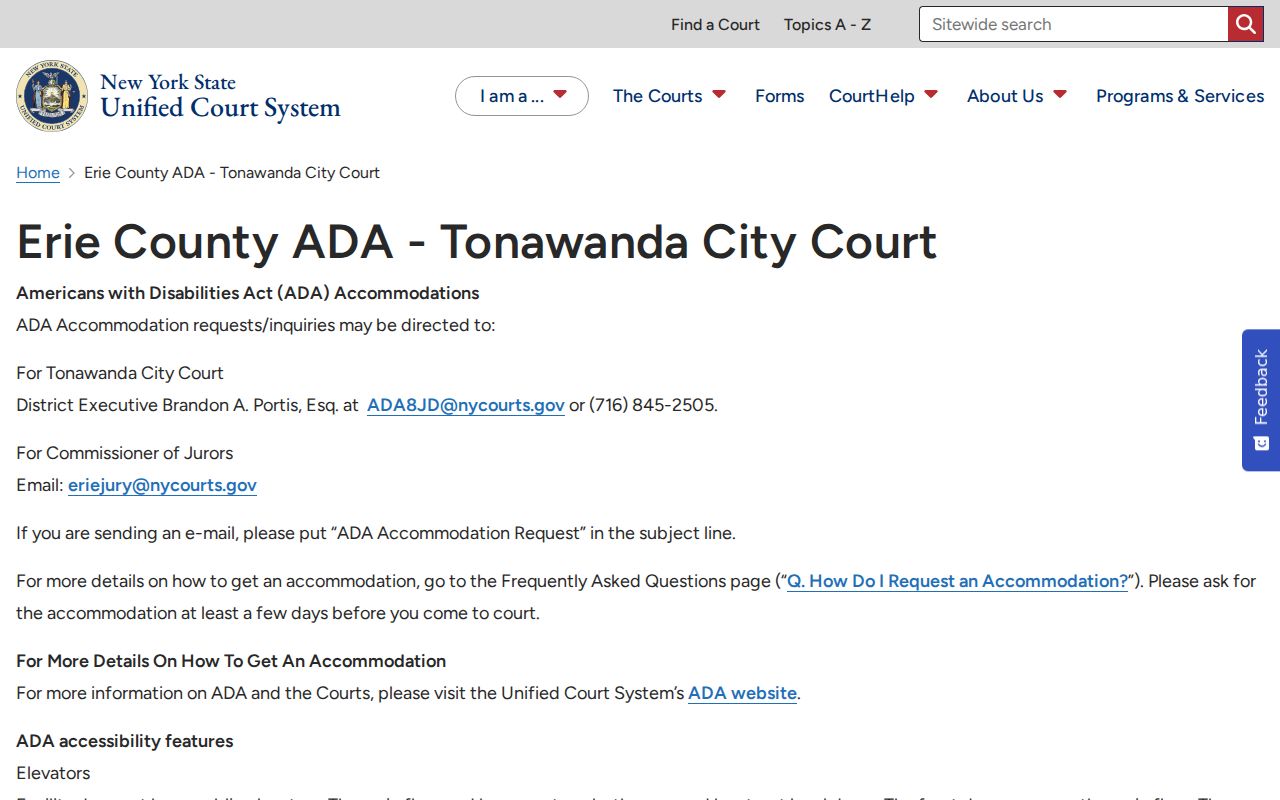 This court keeps city-level matters while indicted felonies move into the Erie County-level system.
Erie County Case Certificates
OCA CHRS is a statewide exact-name and birth-date extraction of public electronic court data. It can report open or pending cases and convictions submitted by covered courts, yet it excludes sealed matters, noncriminal violations, federal cases, youthful-offender-eligible pending matters, and other listed categories. It is not certified. Each name and birth-date combination is a separate $95 search.
A Certificate of Disposition comes from the court that decided the case. It is the better Erie County record when the precise certified outcome matters or when a person needs to correct their own DCJS history. If a felony ended in County Court, start with that clerk. If the case remained in Buffalo, Lackawanna, Tonawanda, or a justice court, request the certificate there.
The Sheriff facility contact table shows why court and custody calls should be kept distinct. 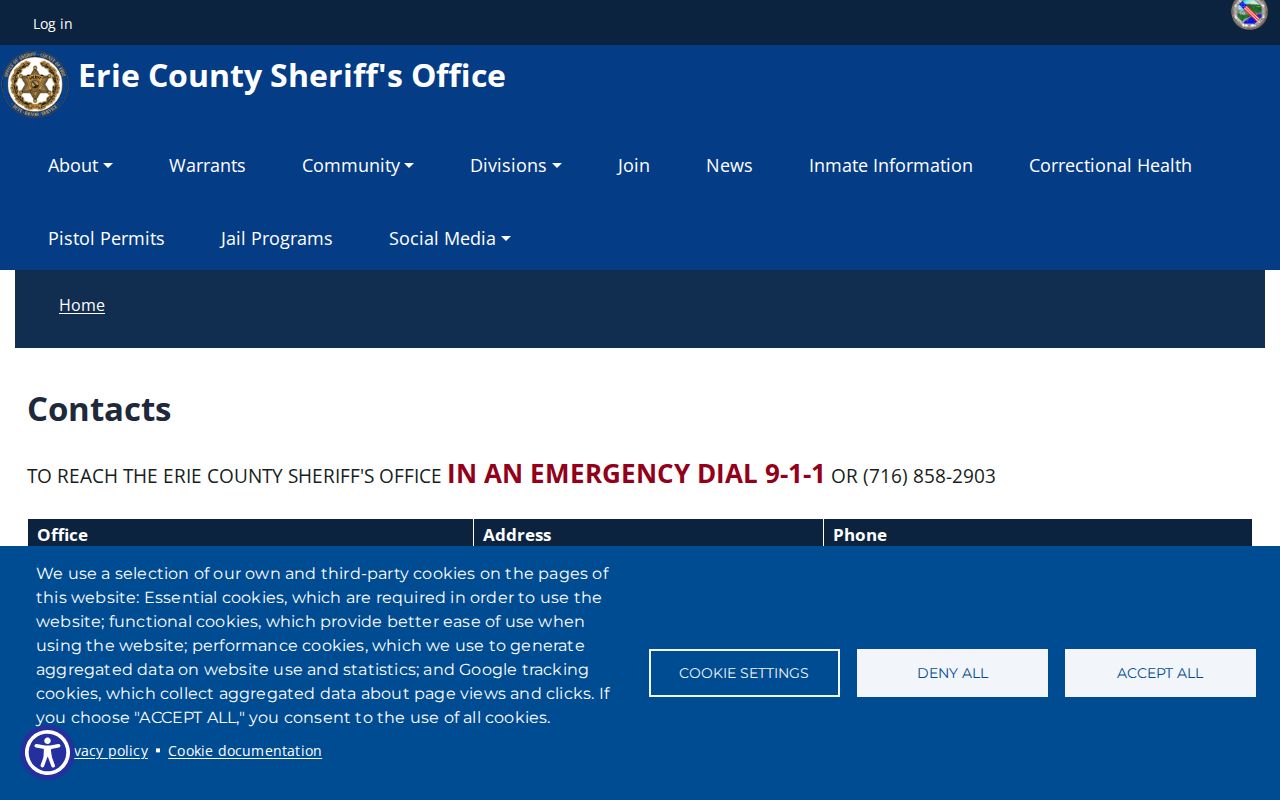 Facility staff can address custody questions, while the court certifies the prosecution's result.
Case Record Access & Restrictions
New York's Freedom of Information Law applies to agency records, but it does not override court sealing. Judiciary Law §255 directs clerks to search and certify court records on a lawful request and fee, subject to confidentiality. Favorable terminations generally seal under CPL 160.50. Application-based sealing under CPL 160.59 and Clean Slate under CPL 160.57 can also restrict access when statutory terms are met.
A sealed Erie County file is generally available only to the defendant or attorney of record unless a court orders otherwise. Online and counter views may also redact private identifiers, victim information, juvenile data, or active-investigation details. When an expected case is absent, ask the clerk whether the issue is jurisdiction, archive status, spelling, or lawful restriction. Do not treat the blank result as proof of what happened.